

Three dice, totals 3–18
Sagar Club K3 Dice
K3 rolls three dice every period. You follow the total, Big or Small, Odd or Even, or look for pairs and triples.
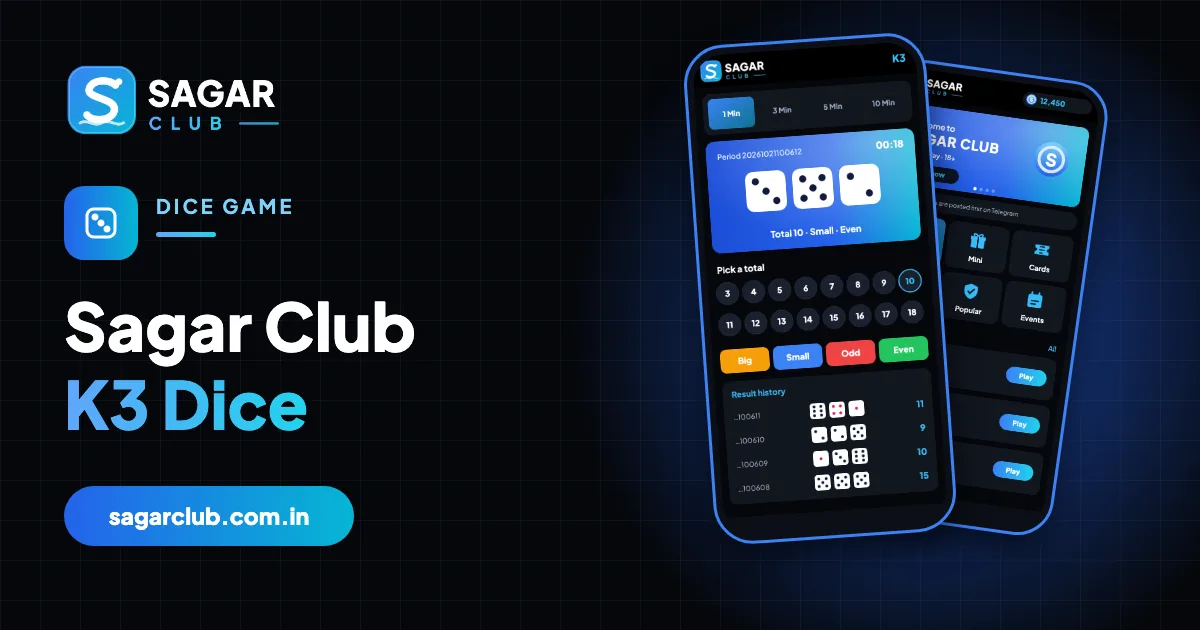
Sagar Club K3 is a dice game built on the same timer and period system as WinGo. At the end of each period three six-sided dice are rolled, and their total – anything from 3 to 18 – is the main result.
K3 is a nice second game because it adds a little maths: some totals come up much more often than others, simply because more dice combinations add up to them.
Contents
- The K3 screen
- K3 options
- How often each total appears
- Pairs and triples
- Reading K3 history
- Beginner tips
- A K3 round, in slow motion
- Why 10 and 11 are the most common totals
- Pairs and triples, explained
- K3 for WinGo players
- Reading the room’s rules
- Real questions from K3 players
- K3 room by room
- A short K3 session plan
- K3 and responsible play
- K3 glossary
- FAQs
The K3 screen
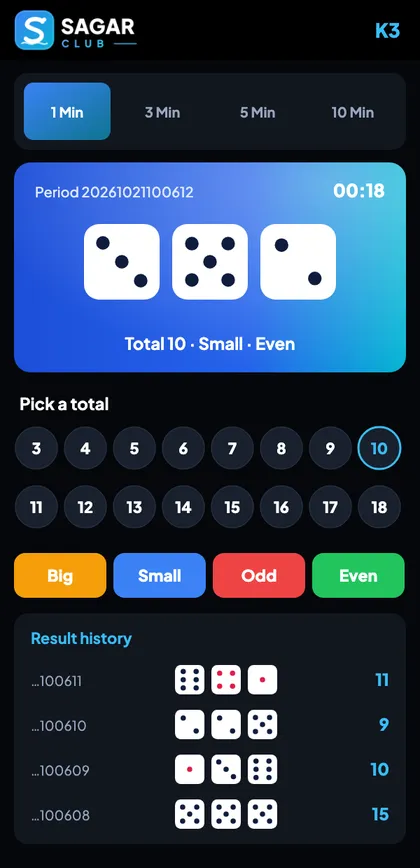
| Part | Meaning |
|---|---|
| Room tabs | 1, 3, 5, 10 Min |
| Dice panel | Last roll and its total |
| Total picker | 3 to 18 |
| Big / Small | 11–18 / 3–10 |
| Odd / Even | Total’s parity |
| History | Each roll with its total |
K3 options
| Option | Meaning |
|---|---|
| Total | The exact sum (3–18) |
| Big / Small | Big = 11–18, Small = 3–10 |
| Odd / Even | Whether the total is odd or even |
| Pair | Two dice match |
| Triple | All three dice match |
How often each total appears
Three dice can land in 216 different ways (6 × 6 × 6). Only one of those makes 3 (1+1+1) and one makes 18 (6+6+6), but 27 make 10 and 27 make 11. That’s why middle totals dominate the history.
| Total | Ways (of 216) | Chance each |
|---|---|---|
| 3 or 18 | 1 | 0.5% |
| 4 or 17 | 3 | 1.4% |
| 5 or 16 | 6 | 2.8% |
| 6 or 15 | 10 | 4.6% |
| 7 or 14 | 15 | 6.9% |
| 8 or 13 | 21 | 9.7% |
| 9 or 12 | 25 | 11.6% |
| 10 or 11 | 27 | 12.5% |
These are fixed probabilities for every roll. They describe the long run; they don’t predict the next roll.
Pairs and triples
A pair means at least two dice show the same face; a triple means all three match. There are six possible triples (1-1-1 to 6-6-6), so a triple appears in 6 of 216 rolls – about once every 36 rolls on average.
Reading K3 history
Each row shows three dice and their total. Glance down the list and you’ll see 9s, 10s, 11s and 12s far more often than 3s and 18s – exactly as the table predicts. More: results history.
Beginner tips
- Start in the 3- or 5-minute room.
- Watch a few rolls before playing.
- Remember Big starts at 11, not 10.
- Read the room’s ⓘ rules once.
A K3 round, in slow motion
A new period begins in the 3-minute room. The dice panel shows the last roll: 2, 5, 5 – total 12, Big, Even, with a pair of fives. You look down the history: 9, 11, 10, 13, 8. As the timer nears zero, picks lock. Three dice tumble and land: 1, 3, 6. Total 10 – Small, Even, no pair. The history updates and the next period begins.
Why 10 and 11 are the most common totals
Imagine listing every possible roll of three dice – all 216 of them. Count how many add up to each total and you get a hill shape: very few at the edges (3 and 18), many in the middle (10 and 11). That’s why middle totals appear so often. It’s a property of dice, not of the app, and it’s the same for every roll – which is also why it can’t be used to predict the next one.
Pairs and triples, explained
| Outcome | Ways | Chance |
|---|---|---|
| Any pair (including triples) | 96 of 216 | About 44% |
| Exact triple (e.g. 4-4-4) | 1 of 216 | About 0.5% |
| Any triple | 6 of 216 | About 2.8% |
| No pair at all | 120 of 216 | About 56% |
K3 for WinGo players
If you know WinGo, K3 will feel familiar: same timer, same period numbers, same lock before zero, same history list. The differences are the result (three dice instead of one number) and the ranges (Big starts at 11, not 5). Keep that one difference in mind and you’ll find K3 straightforward.
Reading the room’s rules
Rooms can differ in details, so open How to play once in each. It lists exactly which options are available in that room and how each is defined.
Real questions from K3 players
“The same total came up three times. Is the game stuck?”
No. Repeats are normal – a total of 10 or 11 has a one-in-eight chance every roll, so seeing it several times in a short spell is common.
“I haven’t seen a triple all session. Is one coming?”
Triples average about one in 36 rolls, but the gaps vary a lot. A long gap doesn’t make the next roll more likely to be a triple.
“Why does Small seem to win more?”
It doesn’t over the long run – Big (11–18) and Small (3–10) each cover exactly half of the 216 outcomes. Short sessions just feel lopsided.
“Can I see the dice for older rounds?”
Yes – the history list shows each roll’s three dice and total. Your own rounds are in Account → Game history.
K3 room by room
| Room | Pace | Feel |
|---|---|---|
| 1 minute | 60 rolls an hour | Quick, little time to think |
| 3 minutes | 20 an hour | Best for learning |
| 5 minutes | 12 an hour | Relaxed |
| 10 minutes | 6 an hour | Very slow – good for watching |
A short K3 session plan
- Open K3, 5-minute room.
- Read How to play.
- Watch two rolls and check them against the tables on this page.
- Take part in a round or two if you want to.
- Stop after 15 minutes and check your history.
K3 and responsible play
Dice games feel friendly and familiar, which makes it easy to forget the clock. Keep the same habits as everywhere: a time limit, slow rooms, regular breaks. If you notice yourself waiting for a ‘due’ total, take that as a cue to stop – see responsible play.
K3 glossary
| Word | Meaning |
|---|---|
| Total | Sum of the three dice |
| Pair | Two dice match |
| Triple | All three match |
| Big / Small | 11–18 / 3–10 |
| Odd / Even | Parity of the total |
Open Sagar Club the right way
Use the official app or website – one Sagar Club account works for login on every device.
Frequently asked questions
What is Big in Sagar Club K3?
A total of 11–18.
How often does a triple appear?
About 1 roll in 36.
Which totals are most common?
10 and 11.